
Rajesh runs a packaging business in Noida. 22 years. Knows every material, every GST rule, every supplier trick. His clients swear by him.
Last month, a potential client searched "custom packaging for D2C brands Delhi NCR" on Google.
Rajesh did not show up. Not on page one. Not on page two. Not anywhere.
The order went to a company half his size. Started 5 years ago. Half the experience. But they had a YouTube channel with 40 videos explaining packaging basics. A LinkedIn page that posted every week. A free Substack newsletter for D2C founders.
That client was worth ₹8 lakh. Gone. Not because Rajesh's product was worse. Not because his price was higher. Because he was invisible.
Now here is the other side. Priya runs an interior design firm in Pune. She heard the same advice two years ago. "Post on social media. Build an audience. Create content."
She tried. Posted on LinkedIn for three months. Got 5 likes on a good day. Zero comments. Zero leads. Felt like shouting in a room where nobody showed up.
She stopped.
Two types of business owners. One never started. One started and quit. Both are sitting on 15 to 20 years of expertise that nobody outside their WhatsApp contacts can find.
Both are making the same mistake
Here is the mistake: both Rajesh and Priya think online content is about reaching strangers. Building a following. Going viral. Getting discovered by random people on the internet.
That is not how this works.
Think about your last week. How many times did someone ask you a question you have answered a hundred times before? A client asking how your pricing works. A prospect asking what makes you different. A new employee asking how your process runs. A referral partner trying to explain your business to someone and getting it half right.
Every time, you typed out a WhatsApp reply. Or spent 20 minutes on a call. Same explanation. Same words. For the 200th time.
You know what that is? That is you doing donkey work. You are a walking, breathing FAQ page. And every answer you give disappears the moment the call ends.
Now imagine this. Someone asks that question. You send them a link. Your blog post. Your LinkedIn article. Your YouTube video. The one where you already explained it better than you ever could in a rushed WhatsApp reply.
| Today (without content) | Tomorrow (with content) |
|---|---|
| Client asks about your process. 20-minute call. | Client asks. You send a 3-minute video link. |
| Prospect asks "why you?" You type a long WhatsApp message. | Prospect asks. You share a blog post with real examples. |
| New employee joins. 2 days of hand-holding. | New employee joins. You hand them a playlist of 10 videos. |
| Referral partner describes you to someone. Gets it half right. | Referral partner shares your post. Gets it exactly right. |
Count the hours. 20 minutes per call, 5 calls a week, 50 weeks. That is 83 hours a year. Answering the same questions. If your time is worth ₹5,000 an hour, that is ₹4 lakh a year spent on repetition.
Your new content does not need to reach strangers. It just needs to replace the explanations you are already giving. Your new distribution piggybacks on your old distribution.
Forget about going viral. Build reusable answers for people who already talk to you. The strangers will come later. The mechanism of how content reaches new people is very different, and I will cover it in a future post. But building the content is always step one. Always.
This is not marketing. This is distribution.
Most business owners hear "online content" and think: marketing. Ads. Reels. Trending audio. Hashtags.
That is not what this is about.
This is about distribution. The same way you think about distribution for your physical product. You want your product available in more places so more people can find it and buy it.
Your knowledge is a product. Your 15 years of solving problems is a product. The advice you give for free over chai is a product.
Right now, that product is only distributed through your mouth. One conversation at a time. Gone the moment the call ends.
Put it on the internet, and it works 24 hours a day. While you sleep. While you are in a meeting. While you are on vacation.
| Distribution channel | What it does | Effort to start |
|---|---|---|
| YouTube channel | People searching for answers find your expertise | 1 video per week |
| LinkedIn page | Your network and their networks see your thinking | 2 posts per week |
| Substack or newsletter | Lands directly in potential clients' inboxes | 1 email per week |
| Instagram or Facebook page | Local and industry audience discovers you | 3 posts per week |
You do not need all four. You need one. Pick the one where your clients already spend time.
The excuse that no longer works
"I do not know how to write."
"I cannot make videos."
"I do not have time to create content."
Two years ago, these were valid excuses.
Not anymore.
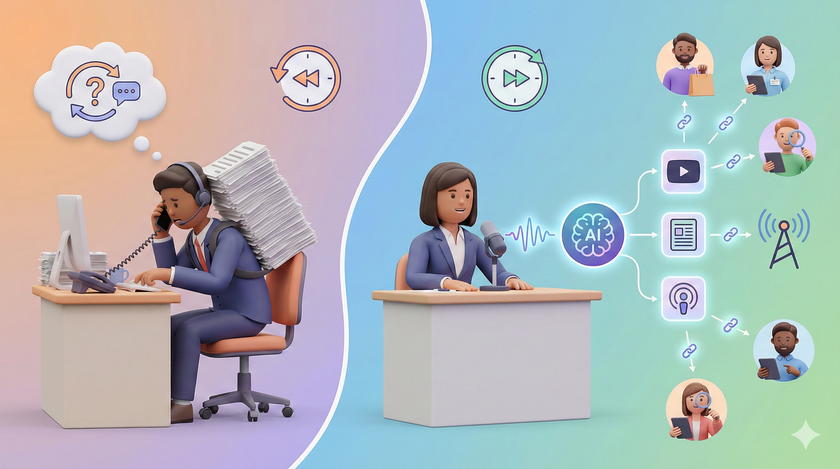
AI has changed this completely. Not by replacing your thinking. By removing the barrier between your thinking and the final output.
Here is what it looks like.
You open your phone's voice recorder. You talk for 5 minutes about a problem you solved for a client last week. What the client was doing wrong. What you recommended. What happened after.
Then you give that recording to ChatGPT, Claude, or Gemini.
The AI does not add expertise. It cannot. It does not have your 20 years. You are the source. The AI just converts your messy, spoken Hinglish into a clean LinkedIn post. Or a newsletter. Or a YouTube script.
| What you bring | What AI does |
|---|---|
| 20 years of industry experience | Structures your thoughts into readable format |
| Real client stories nobody else has | Cleans up grammar and flow |
| Original opinions from the trenches | Suggests headlines and hooks |
| Deep domain knowledge | Converts one recording into multiple formats |
This is not AI slop. AI slop is when someone with zero knowledge asks AI to write about a topic they have never lived. The result reads like every other post on the internet. Generic. Empty. Obvious.
What you are doing is the opposite. You lived it. You solved it. You have the scars. AI is just the translator between your brain and the page. Your experience is the raw material. AI is the packaging.
The business owner who says "I do not have time to create content" spends 83 hours a year answering the same questions on calls. Record one of those answers. Let AI clean it up. Post it. Done. That call you were going to have anyway just became a piece of content that works for you forever.
What to do this week
- Write down the 5 questions people ask you most often. Client questions. Prospect questions. Employee questions. These are your first 5 pieces of content.
- Pick one channel. If your clients are professionals or other businesses, pick LinkedIn. If they are consumers, pick Instagram or YouTube. If you want a dedicated audience, start a free Substack newsletter.
- Record yourself answering the first question. Open your phone's voice recorder. Talk for 5 minutes. Do not script it. Talk like you would explain it to a friend over chai.
- Paste the transcript into an AI tool. Give it this prompt: "Convert this into a LinkedIn post. Keep it under 200 words. Use simple language. Do not add anything I did not say."
- Post it, then use it. The next time someone asks you that question, send them the link instead of typing out the answer again.
Stop answering the same question twice. That is your minimum viable distribution.
What do you think? Post your thoughts in the comments.