You have used AI. You have asked it to write an email. Summarize something. Maybe rewrite a message to sound more professional. You know it works.
Then someone at a dinner says "you should use AI more." Your CA says it. Your cousin's son says it. That guy on LinkedIn who posts every day says it.
You agree. You nod. You open Claude. Or Gemini.
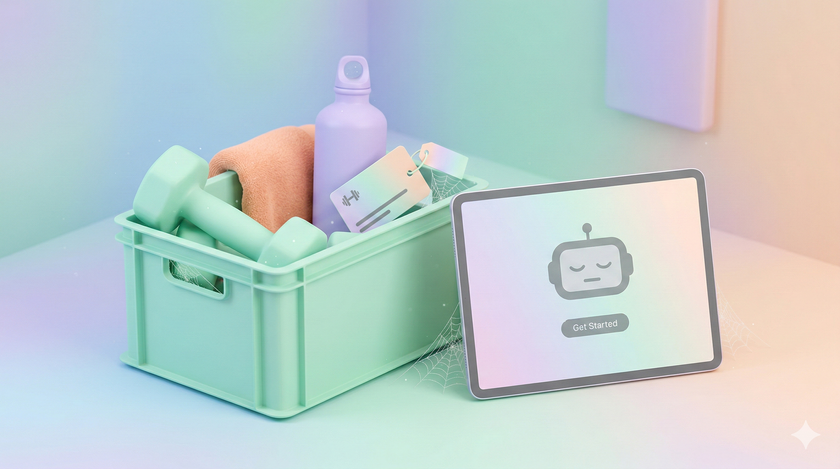
Blank box. Blinking cursor.
You sit there. Nothing comes to mind. You close the app.
It is not that you do not know how to use AI. You have used it. The problem is simpler than that.
Nobody ever told you when to open it.
Why you use Google Maps ten times a week and AI once
Think about Google Maps. You did not take a course on it. Nobody gave you a framework. No one explained "10 use cases for Google Maps."
You use it because there is an obvious moment in your day that triggers it. You need to go somewhere. You open Maps. Every single time.
The trigger is built into your workflow. "I need to go somewhere" means open Maps. No thinking required. No decision. No blank screen problem.
Now think about AI. When are you supposed to open it? There is no trigger. There is no moment in your day that says "now open Claude" or "now open Gemini." You open it only when you remember to. And you remember to only when someone reminds you.
This is not a skill problem. This is a trigger problem.
The fix is not learning. It is stacking.
Google Maps works because it is stacked into something you already do. You were already going somewhere. Maps just plugs in right before.
AI works the same way. You do not need new tasks for AI. You need to plug AI into tasks you already do. Right before you do them.
The trigger is not "I should use AI today." The trigger is "I am about to do something. Let me ask AI first."
Here is what that looks like.
| You are about to... | Stack AI before it |
|---|---|
| Drink your morning chai and read the news | Ask Claude: "Summarize today's top 5 business news for India" |
| Decide what to eat for lunch | Ask Gemini: "Suggest something new to eat near my area. Not paneer again." |
| Reply to an angry customer on WhatsApp | Paste the message into Claude: "Draft a calm, polite reply to this" |
| Send a price quote to a buyer | Ask Gemini: "Check this quote email for mistakes before I send it" |
| Scroll Netflix trying to find something to watch | Ask Claude: "Suggest a show like Scam 1992 I can finish in a weekend" |
| Post something on your business Instagram | Ask Gemini: "Give me 3 short caption ideas for this product photo" |
| Call your CA about a tax question | Ask Claude: "What questions should I ask my CA about [topic]?" |
| Buy something expensive. AC, laptop, raw material. | Ask Gemini: "Best [item] under ₹[budget]? What should I check before buying?" |
| Talk to your team on Monday morning | Ask Claude: "Give me 3 good questions to ask about last week's work" |
| Read a long email or supplier quotation PDF | Paste it into Gemini: "Summarize this in 3 bullet points" |
| React to a new government rule. GST, labour law. | Ask Claude: "How does this new rule affect a small business like mine?" |
| Gift something. Festival, birthday, family function. | Ask Gemini: "Suggest 3 gifts under ₹2,000 for my wife's birthday" |
| Plan your weekend with family | Ask Claude: "Fun family activities this weekend near Jaipur, budget ₹3,000" |
| Someone recommends a book or podcast | Ask Gemini: "Is this worth my time? Key takeaways in 5 lines." |
Notice the pattern. You are not learning a new skill. You are not adding a new task to your day. You are inserting a 2-minute step before something you were going to do anyway.
Just like Maps. You were already going somewhere. Maps just made the trip better.
AI is also your discovery tool
There is one more thing Maps does that people forget. Discovery. You do not just use Maps to navigate. You use it to find things. "Restaurants near me." "Petrol pump nearby." "Best rated mechanic in my area."
AI does the same thing. But for everything.
"I like cooking and I want a really good knife. What is the best knife I can buy in Pune under ₹5,000?"
"My back hurts from sitting all day. What is a good office chair for long hours? Something available on Amazon India."
"I want to start walking in the mornings. What are good routes near Koramangala that are safe at 6 AM?"
You already search for things like this on Google. The difference is that AI gives you a direct answer instead of 10 blue links and 4 ads. One question. One useful answer. No scrolling.
Why this works and courses do not
Every AI course starts with "here is what AI can do." They show you 50 use cases. You feel inspired for 3 days. Then you forget everything because none of those use cases connect to your actual Tuesday morning.
Stacking is the opposite. You do not start with AI. You start with your day. Your chai. Your calls. Your WhatsApp messages. Your decisions.
Then you ask one question: "Which of these would be better if I asked AI first?"
The answer is almost all of them.
What to do right now
Open your phone. Open the alarm clock. Spin the time wheel to a random time. If it lands somewhere in your normal waking hours, save it. Set it to repeat every day.
That is it. That is the whole system.
When this alarm rings tomorrow, do not dismiss it. Not until you look around, think about what you are doing or about to do, and ask AI one question about it.
Standing in the kitchen? "What can I make with paneer and the leftover capsicum in my fridge?"
Sitting in a meeting that is going nowhere? "How do I politely end a meeting that has no agenda?"
About to message a vendor? "Make this message shorter and more professional."
Just read a WhatsApp forward about a new tax rule? "Explain this in simple terms. Does it affect my business?"
The question does not have to be brilliant. It does not have to be about business. It just has to be about whatever is in front of you at that moment.
Do this for one week. One random alarm. One question a day. By day four, you will not need the alarm. Your brain will start doing it on its own. "I am about to do this thing. Let me ask AI first."
That is when AI stops being an app on your phone and starts being part of how you think.