
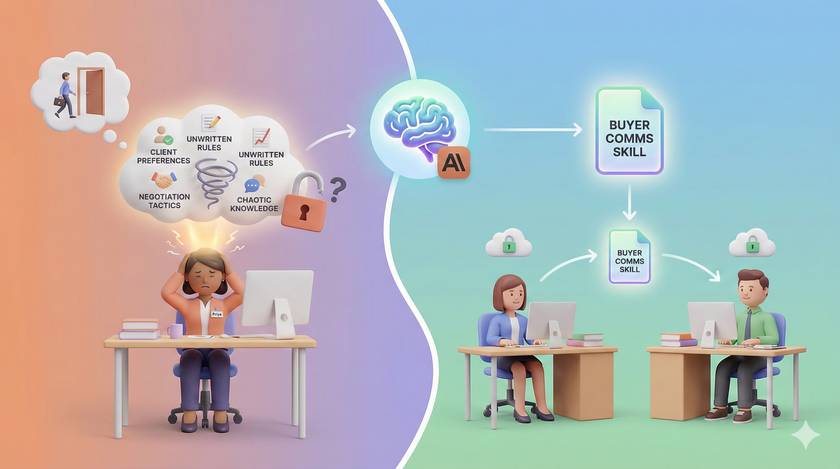
Priya has been with you for 4 years. She handles all buyer communication. She knows that Mehta Industries wants delivery terms before payment terms. She knows that Gupta Traders gets offended if you mention MOQ in the first message. She knows that international buyers need a firmer tone and domestic buyers need warmth.
None of this is written anywhere.
Last month, Priya went on medical leave for two weeks. Her replacement, Sneha, sent Gupta Traders a message with MOQ in the second line. Gupta ji called you directly. "Neha ji, who is this new person? She does not know how to talk to us."
You apologized. You handled it yourself. For two weeks, you were Priya again.
Now imagine Priya leaves. Not for two weeks. Forever.
Three weeks of fumbling. Clients noticing the drop in quality. Gupta ji shopping around. Mehta Industries getting irritated. And you, sitting there, realizing that 4 years of Priya's judgment, tone, and client knowledge just walked out the door.
This is not a Priya problem. This is a systems problem. The knowledge that runs your business lives inside people's heads. When the person leaves, the knowledge leaves.
The ₹6 lakh problem nobody calculates
Every time a senior person leaves, you lose 3-4 weeks of productivity from their replacement. But the real cost is what you cannot see.
Priya handled 15 buyer conversations a day. Each conversation influences whether the client stays, orders more, or drifts to a competitor. Four bad weeks of communication. Fifteen conversations a day. That is 300 client touchpoints handled by someone who does not know your business yet.
How many of those 300 touchpoints cost you a repeat order? Even if it is 5%, and your average order is ₹40,000, that is ₹6 lakh. Gone. Because the knowledge was in Priya's head and not in a system.
And this happens every single time someone leaves. Or goes on leave. Or you open a new branch and the new team has no idea how things are done at headquarters.
What most people try (and why it fails)
Most business owners try to solve this with documentation. SOPs. Training manuals. The 40-page Word document that someone writes once and nobody reads again.
The problem with documentation is simple. Nobody follows it in the moment. When Sneha is typing a message to Gupta Traders at 4 PM with three other clients waiting, she is not going to open a 40-page document, search for "Gupta Traders preferences," and read paragraph 17.
She is going to type what feels right. And what feels right to someone who joined last Monday is not what feels right to someone who has been here for 4 years.
Some owners try custom instructions in ChatGPT or Claude. "Always use a professional tone. Always include payment terms." The problem is that custom instructions are always on. Every conversation. Every task. It is like telling every employee the same thing regardless of their role. Your buyer communication rules should not interfere when you are brainstorming product ideas.
Skills. The thing that actually works.
Claude has a feature called Skills. Most people have not used it. Here is what it does.
You explain how you want a specific type of work done. In plain language. The way you would explain it to a smart new hire on their first day. Claude turns that explanation into a structured set of rules it follows every time that type of task comes up.
You say: "When I draft a message to a buyer, always include our MOQ of 500 pieces, lead time of 30 days, and payment terms of 50% advance. Never offer discounts unless I say so. For Gupta Traders, never mention MOQ upfront. For international buyers, use a firmer tone. Loop in Amit on orders above ₹2 lakh."
Claude creates a skill from that. The "Buyer Communication" skill.
Now here is the important part. This skill only activates when you are drafting a buyer message. When you are brainstorming marketing ideas or summarizing a report, it stays asleep. No interference. The right rules for the right task.
And it gets better over time. First draft not right? You say "put delivery terms before payment terms." Claude updates the skill. Next time, better. The week after, even better. You are training an employee who never forgets what you taught them.
| SOPs and manuals | Skills |
|---|---|
| Written once. Read never. | Active every time the task happens. |
| Sits in a folder. Sneha has to find it. | Activates automatically when relevant. |
| Same instructions for everything. | Different skill for different tasks. |
| Cannot improve itself. | Gets better every time you give feedback. |
| Cannot be shared easily. | Transfer to anyone in two clicks. |
The part that changes everything
You can transfer a skill to anyone. Your business partner. Your branch manager in Indore. Your new hire who joined last Monday.
They do not need to shadow Priya for two weeks. They do not need a 3-hour onboarding session where they take notes they will never read. They add the skill to their Claude. Done.
Same rules. Same quality. Same judgment. Day one.
Think about what this means for a business with multiple branches. Your Jaipur branch handles clients one way. Your Indore branch handles them another way. Your Lucknow branch has a new team that is still "learning the culture." Three branches. Three different levels of quality. Because the knowledge lives in different people's heads.
One skill. Three branches. Same quality. From day one.
I have seen this pattern in hundreds of businesses. The owner builds something excellent in one location. Then spends years trying to replicate it in the next location. The bottleneck is never the process. It is the transfer of judgment. How do you teach someone the instinct that took Priya 4 years to develop?
You do not teach it. You encode it. And then you transfer it.
How to set it up (15 minutes)
- Open claude.ai. You need a Pro plan (starts at $20/month). Go to Settings. Under Capabilities, turn on "Code execution and file creation." On the same page, you will see a Skills section. Toggle on the skills that are already there. That is it. Skills are now active.
- Pick one task that only one person in your office does well. Buyer communication. Vendor follow-ups. Client complaint handling. The task where everyone says "only Priya knows how to do this right."
- Open a new conversation. Type: "I want to create a skill for how I handle buyer communication. Here is how it should be done..." and explain it the way you would to a new hire. What matters. What to never do. Which clients need special treatment. What tone to use. Be specific. Claude will ask you follow-up questions, build the skill, and package it as a file you can download.
- Go back to Settings. Under Skills, upload that file. Toggle it on. From now on, every time you ask Claude to draft a buyer message, it will follow those rules automatically. You do not need to remind it. You do not need to paste instructions. The skill activates on its own when the task matches.
- Test it for a week. Every time the output is not quite right, tell Claude: "Update the skill. Make the tone warmer." Or "Always mention delivery timeline before price." Or "For orders above ₹5 lakh, add a line about dedicated support." Each correction makes the skill sharper. By Friday, it will handle that task better than most of your team.
- Share the skill file with one other person in your office. They upload it to their Claude. Same rules. Same quality. Day one.
Your best employee will leave someday. The question is whether their knowledge leaves with them.
What do you think? Post your thoughts in the comments.