
Rajesh runs a packaging supplies business in Pune. Good products. Fair prices. Decent website. He even runs Google Ads.
Last month, 74 people filled his "Get a Quote" form.
His sales guy Manish called back 52 of them. The other 22? Manish was busy. Or forgot. Or the lead came in at 9 PM on a Saturday.
Of the 52 he called, 11 picked up. Of those 11, 6 said "I already bought from someone else."
Rajesh spent ₹38,000 on ads. He closed 3 orders.
He blames the ads. He blames the market. He blames the economy.
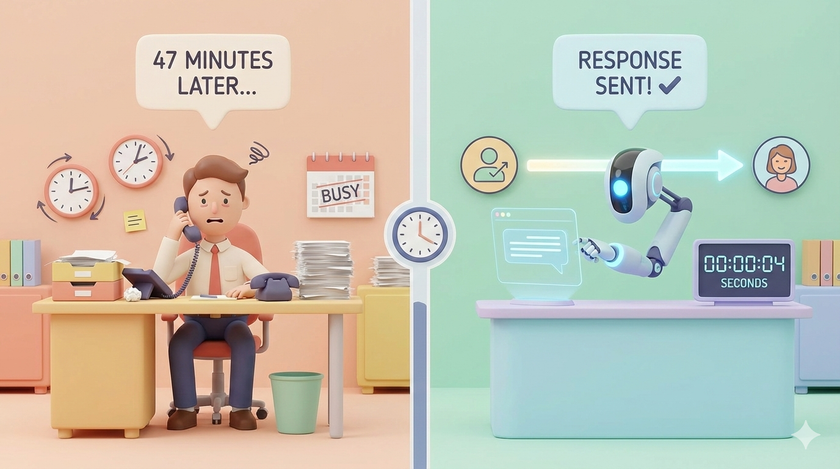
He should blame the 47-minute gap.
The 47-minute problem
Here is what happens when someone fills a form on your website.
They are interested RIGHT NOW. They are comparing three vendors. They have the budget open. They want to buy.
Every minute you take to respond, the chance of converting that lead drops. Not gradually. Sharply.
After 5 minutes, the lead is 10x less likely to convert than if you had responded in the first minute. After 30 minutes, most leads have already moved on. After 2 hours, you are calling a stranger who has forgotten they filled your form.
Your sales guy responds in an average of 47 minutes. On a good day. On a bad day, it is tomorrow morning.
The customer is not running away from your product. The customer is running away from your response time.
What your sales guy actually does all day
This is not about blaming Manish. Manish is doing his best. But look at what his day looks like.
| Task | Time spent | Revenue generated |
|---|---|---|
| Calling old leads who do not pick up | 2 hours | ₹0 |
| Typing the same product details on WhatsApp for the 14th time today | 1.5 hours | ₹0 |
| Explaining pricing, MOQ, delivery timelines (same answers, different customer) | 1.5 hours | Maybe |
| Following up with "Sir, did you check the quote?" | 1 hour | ₹0 |
| Actually closing a deal | 1 hour | Yes |
| Lunch, chai, bathroom, random office conversations | 1 hour | ₹0 |
Manish spends 6 out of 8 hours doing things that do not need a human brain.
Typing the same message. Answering the same question. Chasing people who are not interested. Sending the same PDF.
And the one thing that DOES need a human brain, closing the deal, gets one hour. On a good day.
The real problem
The problem is not Manish. The problem is you are using a human to do a machine's job.
Greeting a customer at 11 PM on a Sunday? Machine job. Sending a price list based on what the customer asked for? Machine job. Following up on Day 1, Day 3, Day 7 with the right message? Machine job. Answering "What is your minimum order quantity?" for the 200th time? Machine job.
Understanding that a customer is hesitant because the last vendor delivered late, and adjusting the pitch accordingly? Human job.
You are paying Manish ₹25,000 a month to do the machine's job. And when the human job shows up, Manish is too tired and too buried in WhatsApp messages to do it well.
What an AI agent actually does
An AI agent is not a chatbot. Forget those "Hi, how can I help you?" boxes that make everyone click the X button.
An AI agent knows your products. It knows your pricing. It knows your delivery timelines, your MOQs, your payment terms. It reads the customer's message, understands what they are asking, and responds like a trained sales person would.
Here is the difference.
| Scenario | Your sales guy | AI agent |
|---|---|---|
| Lead comes in at 10:30 PM | Sees it next morning at 10 AM | Responds in 4 seconds |
| Customer asks for pricing of 3 products | Sends one PDF with everything, tells customer to "check page 4" | Sends exact pricing for those 3 products, formatted cleanly |
| Customer goes quiet for 3 days | Forgets, or sends "Sir any update?" | Sends a specific follow-up based on what the customer last asked about |
| 15 leads come in during lunch hour | 12 get missed | All 15 get a response within seconds |
| Customer asks in Hindi | Manish replies in Hindi | Agent replies in Hindi. Or Marathi. Or Tamil. Whatever the customer wrote in. |
| Saturday, Sunday, Diwali, Holi | Off | On |
The AI agent does not replace Manish. It replaces the 6 hours of Manish's day that do not need Manish.
Manish now only talks to leads who are already warmed up, already have pricing, already know the product fits their needs, and are ready to close.
Manish goes from closing 3 deals a month to closing 12.
Try this today (15 minutes)
You do not need to build a full AI agent to see how this works. Try this simple test.
- Open ChatGPT or Claude.
- Paste this prompt:
You are a sales assistant for my business. My business sells [YOUR PRODUCT]. Our pricing is [YOUR PRICING]. Our minimum order quantity is [YOUR MOQ]. Our delivery timeline is [YOUR TIMELINE]. A customer sends you this message: "Hi, I need pricing for [PRODUCT NAME]. Can you deliver to [CITY]?" Respond like a helpful, professional sales person. Keep it short. Be specific.
- Replace the brackets with your actual business details.
- See the response.
Now compare that response to what your sales guy typically sends.
That is one message. One static prompt. Imagine an agent that does this automatically, 24 hours a day, across WhatsApp, email, and your website. One that remembers the conversation, follows up on its own, and hands the lead to your sales team only when the customer is ready to buy.
That is what a properly built AI sales agent does.
The gap between the prompt and the agent
That prompt you just tried? It works for one message. A real AI agent needs to handle conversations across days. It needs to pull data from your inventory. It needs to know when to push and when to back off. It needs to integrate with your CRM or your Google Sheet or your WhatsApp Business account.
The gap between "I tried a prompt" and "I have a working agent" is where most people get stuck. It is not a technology problem. It is a systems design problem.
In my AI workshops, I teach business owners how to build these agents end to end. From the first prompt to the final integration. No coding background needed.
But even without that, the prompt test above will show you something important. It will show you that the answers your customers need can be generated in 4 seconds. Not 47 minutes.
What to do this week
- Run the prompt test above with your actual business details. Spend 15 minutes. See the quality of response AI gives versus your current process.
- Ask your sales guy one question: "How many leads from last week did you respond to within 5 minutes?" Write down the number.
- Check your Google Ads or website form data. Count how many leads came in outside business hours last month. Those are the leads you lost before your sales guy even started his day.
The data will tell you the story. You do not need me to convince you.
Your customers are not disloyal. They are impatient. And they should be. Because your competitor's AI agent just replied to them in 4 seconds while your sales guy was on a chai break.