
Aneesa Naik is the second-generation partner of Pioneer Marine Refrigeration and HVAC in Mumbai. Her team of 42 builds, services, supplies and rebuilds air-conditioning, ventilation and refrigeration systems for ships, tugs, offshore platforms and shore plants. The clients are refineries, shipyards and fleet owners. The kind of customers who do not forgive a cooling failure at sea.
The company is three and a half years old and growing. And until recently, the business inside the business ran on email threads and evening phone calls.
Enquiries arrived by email, and some got missed. Site progress lived in whatever the engineers reported on the phone at night, or on WhatsApp. Revenue was known only after accounts caught up. Tenders were lost in silence, with nothing to learn from. Salary processing was a manual job of three to four days, every single month. The books ran on Tally, on one machine.
If you run a services business, you did not read that paragraph. You recognized it.
The expensive silence
Here is the part worth sitting with. The most dangerous thing in Aneesa's company was not a breakdown or a complaint. It was silence.
A quiet inbox could mean no new enquiries, or it could mean an enquiry sitting unread in someone's mailbox. A quiet tender result meant a loss nobody would ever study. Silence looked like calm. It was actually the leak.
"Earlier, every quiet phone was a worry: a missed enquiry, a lost tender we'd never understand. Now everything is on a screen, and a problem I can see is just a problem to solve."
This is the condition almost every engineering-led business lives in. The best systems thinking goes into the product. Ships get precision cooling. The office gets email and memory.
Aneesa did not need a lecture on what was broken. Read her description of the mess again. She could name every leak precisely. What she needed was each of those problems translated into a tool simple enough to deploy inside a working 42-person marine services company, without stopping the ships.
So that is what we did.
What actually worked
| System | What it replaced | What changed |
|---|---|---|
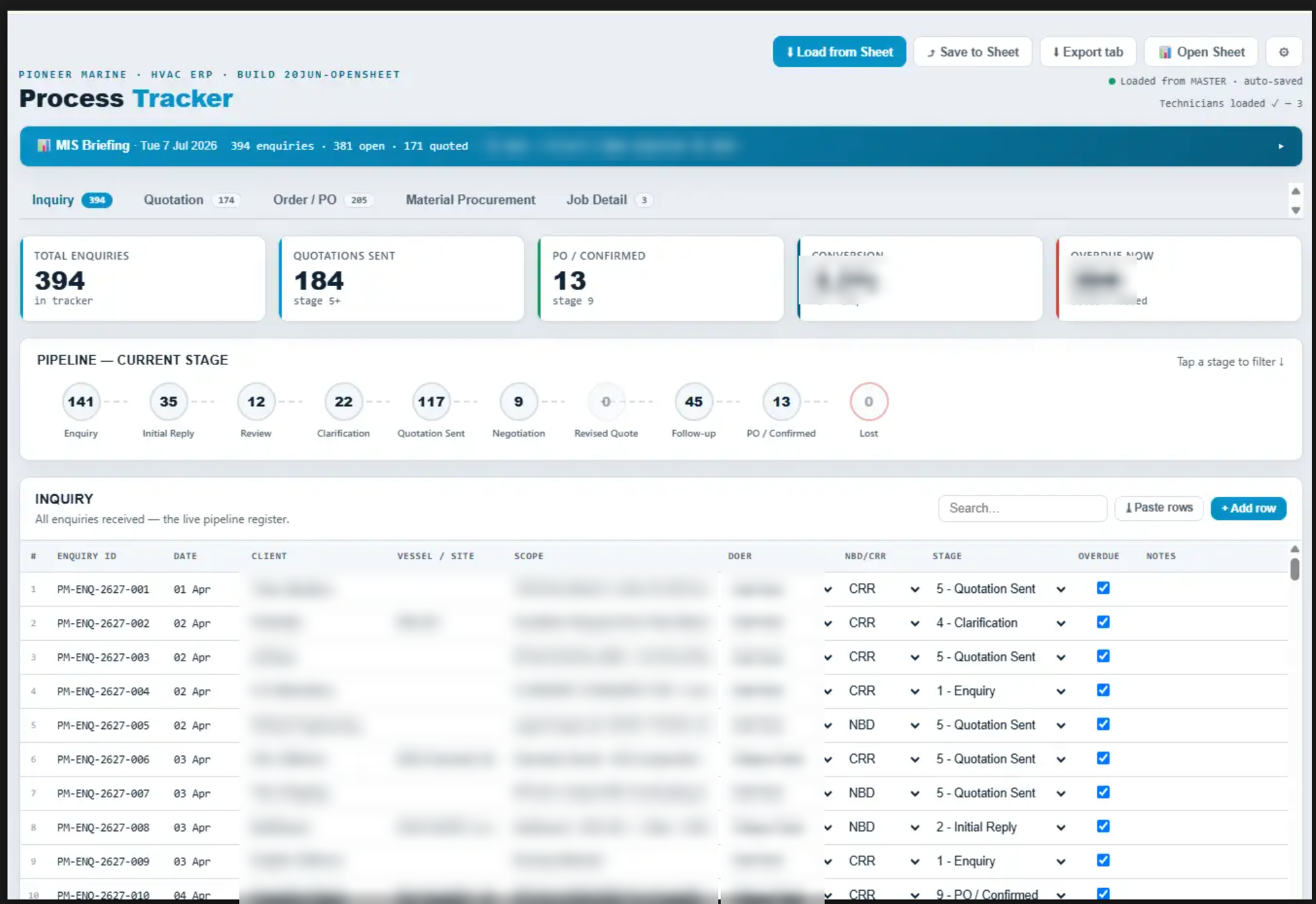
| Automated Sales MeCA | Enquiries scattered across inboxes and memory | Every email enquiry flows into one sheet automatically, with NBD-CRR tracking and live lead status |
| Revenue tracker | Revenue known after accounts caught up | Reads every PO received and shows monthly and quarterly revenue, live |
| Project status automation | Evening phone calls and WhatsApp updates | Every project tracked from PO receipt to completion, site work recorded with AI |
| Automated tender analysis | Tenders lost in silence | Every loss analyzed, pricing gaps visible |
| Zoho Books | Tally on one machine | Cloud accounting with corrected methods, numbers visible from anywhere |
| Payroll automation | A three to four day manual job every month | Attendance from any site becomes payroll and salary slips in a few clicks |
The sales engine came first.
"Every enquiry flows from email into one sheet automatically, with NBD-CRR tracking and live status of every lead."
No enquiry depends on someone remembering to forward an email anymore. Each lead carries a status that someone owns.
The money layer came next. The revenue tracker reads every purchase order the moment it lands and turns it into live monthly and quarterly numbers. Tally on one machine gave way to
Zoho Books, and the migration came with corrections to the accounting method itself. The numbers are not just visible now. They are correct.
Then the people layer. Attendance from any site, ship or shore, now processes into payroll and salary slips in a few clicks. Site progress is tracked and recorded with AI instead of reconstructed from evening calls. And with SEO, Google Ads and sales training running alongside, the pipeline keeps filling the systems built to organise it.
What moved
Payroll went from three to four days a month to a few clicks. Missed enquiries are effectively zero. Revenue is visible live instead of after the fact.
And the tender analysis surfaced something nobody could see before: on routine servicing, their quoted rate was roughly three times the winning bid. For the first time, a lost tender came with a reason. A reason can be fixed.
But the number that matters most is not on any dashboard.
"I can finally be a partner instead of a coordinator. My day used to be spent reconstructing what had happened. Chasing emails, calling sites, checking who got paid. Now the systems tell me what happened, and I spend my time deciding what to do about it: pricing, clients, growth."
And at home:
"I'm actually there. The month-end payroll marathon is gone, and I'm not carrying the whole business in my head after hours, wondering which email slipped. When nothing depends on my memory, the evenings belong to my family again."
Read that last line twice. That is what payroll automation actually buys.
The lesson sitting in plain sight
This is not a story about a founder who did not understand technology. Aneesa runs a company that keeps cooling systems alive on offshore platforms. Understanding was never the gap.
The gap was translation. Someone had to take each problem exactly as she described it and hand back a tool simple enough to run the same week. Missed emails, silent tenders, the payroll marathon: each one got a tool, not a theory. A problem named in your own language, plus a frictionless tool, equals the result. That formula, repeated six times, is this entire story.
Asked at the end of the form if she wanted to add anything, Aneesa wrote four words.
"Complete automation of business."
If your ships, rigs or shore plants need marine air-conditioning, ventilation or refrigeration work, Pioneer Marine Refrigeration and HVAC is the team Aneesa built in Mumbai. Tell them TechEssentials sent you.
Your story is sitting in a drawer
Aneesa spent about ten minutes on a form and attached a photo and two screenshots. That is all it took to turn three and a half years of work into the story you just read.
You have one of these too. A mess you cleaned up. A system that gave you your evenings back. Right now it is sitting in a drawer where no customer, no peer and no Google search will ever find it.
Tell me what you cracked, and I will write it up just like this. Start here: You Did The Work. Nobody Online Knows You Did.
The evenings are waiting.