Rajesh runs a packaging business in Pune. ₹14 crore turnover. Twenty-two staff. He has been "thinking about" buying Claude Pro for his team for six months.
Every month he opens the pricing page. Every month he sees a slightly different number in rupees. He notices the number. He does not notice the trend.
A year ago Claude Pro cost him about ₹1,700 a month. Today it costs ₹1,920. Anthropic did not raise the price. The rupee did.
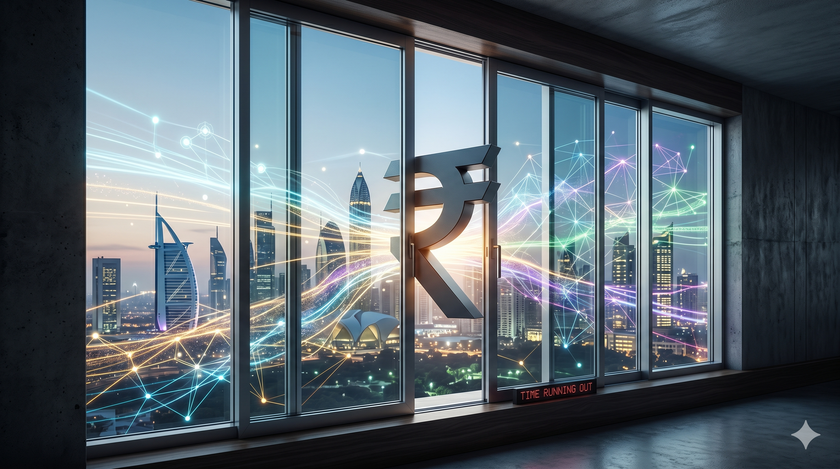
The dollar problem just got bigger.
For fifty years India has paid for oil in dollars. We do not have oil. We have rupees. So every shipload of crude leaves the country in dollars and the rupee weakens by a fraction.
This is one of the reasons why one US dollar cost ₹18 in 1991, ₹46 in 2010, ₹74 in 2020, ₹85 in 2025, and ₹96 today. That is over 43% weaker in the last decade alone, and 12.62% weaker in the last twelve months. The rupee did not crash. It bled. Slowly. Quietly. One barrel at a time. Now it is bleeding faster.
Now we have a second dollar bill landing in the mailbox. AI.
Every ChatGPT subscription is paid in dollars. Every Claude Pro seat. Every OpenAI API call your developer makes. Every AWS Bedrock invoice. Every minute your team spends on Cursor, Notion AI, Perplexity, Lovable. Every US-built AI tool your CA uses to read GST notices faster.
These dollars leave the country the same way oil dollars do. They do not come back.
You are looking at the wrong year.
In 2025 India spent around ₹12 lakh crore on oil imports. AI's outflow today is a fraction of that. Three or four thousand crore. Small.
That is the wrong number to look at.
Look at 2028.
AI is on the exact curve cloud was on in 2014. Back then AWS was a curiosity for Indian businesses. By 2024 Indian companies were sending out roughly ₹50,000 crore a year to US cloud providers. The curve did not ask permission. It did not wait for adoption committees. It happened.
By 2028 India's AI dollar outflow will not be ₹3,000 crore. It will be ten or twenty times that. Claude, ChatGPT, Gemini, Perplexity, Cursor, xAI. Each one is a US company sending you an invoice. Each one is your next dollar bill. Multiplied by every business in your sector that figured it out before you did.
Oil plus AI. Both priced in dollars. Both leaving the country. One mature, one accelerating.
The rupee is not going to enjoy this. They do not come back.
True. AI is a more useful dollar than oil. The trouble is that the productivity accrues to you, in rupees, while the dollar accrues to Anthropic, in dollars. Unless your AI productivity wins you export contracts paid in dollars, your business gets richer in rupees and India gets poorer in dollars.
And then there is the other scenario.
What if AI does not grow? What if the bubble bursts?
Anthropic, OpenAI, and the rest are burning billions to keep prices low. That subsidy is paid by venture money and by hyperscaler capex on Nvidia chips. When that capex stops, and serious analysts say it will, the bill comes due.
In that world, AI prices do not fall. They rise. Free tiers tighten. Enterprise plans get gated. The few survivors gain pricing power and use it. And the same tech-sector panic that causes the bust pushes global capital out of emerging markets and into the dollar. The rupee gets hit twice. Once on the import bill. Once on the capital account.
So one of two things happens over the next three years. Either AI succeeds and the dollar outflow scales. Or AI consolidates and the prices spike. Both paths end in the same place. The window where AI is this cheap, in rupees, is open right now. It is not going to stay open.
There was one escape route. It just closed.
For a while, you could opt out of all of this. Buy your own hardware. GPUs, RAM, storage. Run open-source models on your own machines, your own electricity, your own godown. No subscription. No dollar invoice. No exchange rate.
Think about what an AI company actually is. Anthropic, OpenAI, Google. They are not magicians. They own machinery that converts electricity into intelligence.
Oil works the same way. A producer has the machinery to pull crude from the ground. Crude becomes fuel. Fuel becomes dollars.
AI has one difference from oil. You do not need oil under your soil. You only need the machinery.
You might be thinking this sounds like crypto. During the crypto rush, every other tech worker in Bangalore had a GPU rig under his desk. They thought they would print money. They were wrong. That is not how money works. Intelligence is different. You get the point, right?
So for the last two years, the smart move was obvious. Buy the machinery. Pay for it once, in rupees. Plug it in. Use it for five years. Skip the dollar subscription forever.
I have personally spent over ₹1 crore now on AI hardware. Before it was too late.
Because that window closed slowly in the last twelve months. You probably did not notice.
On December 19, 2025, I sent this message in the BMP July 2025 Batch group.
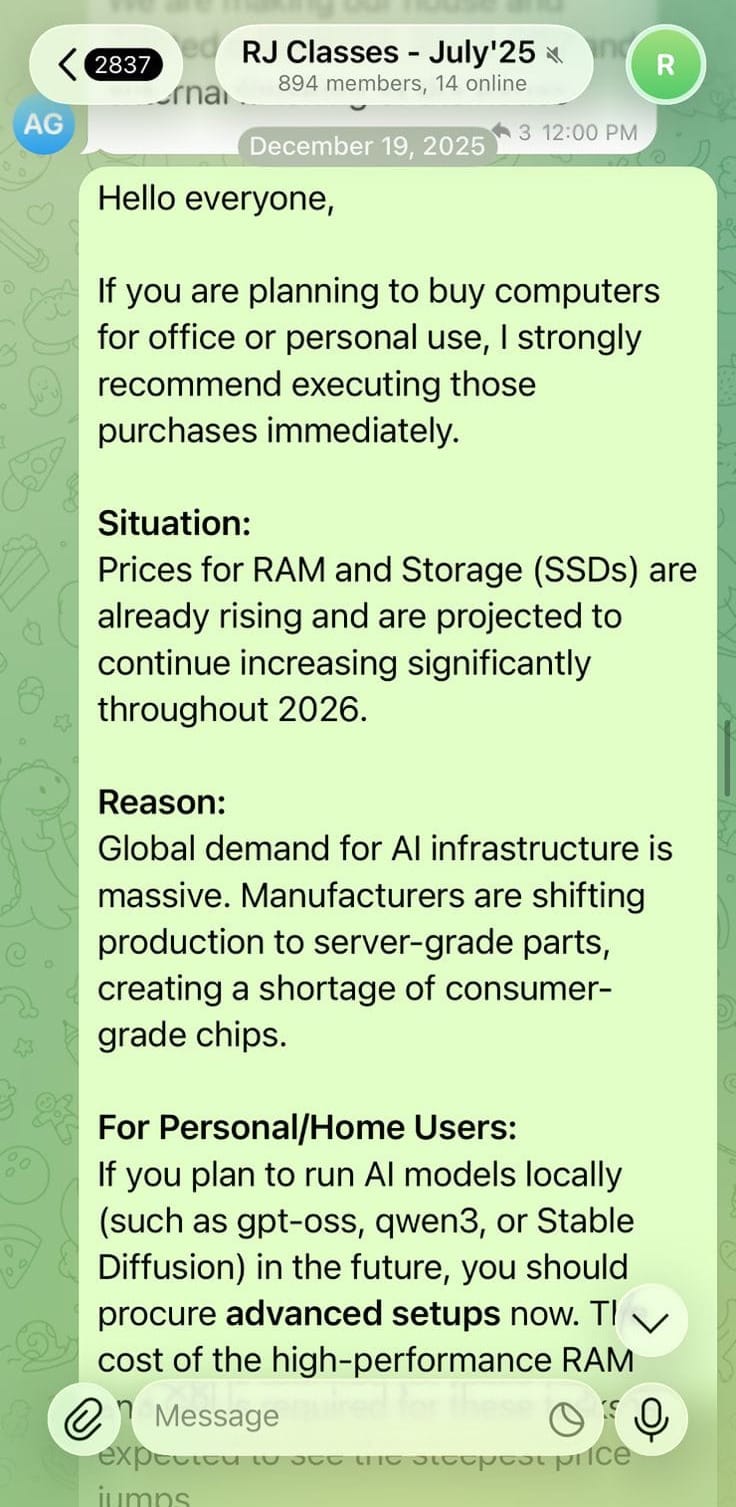
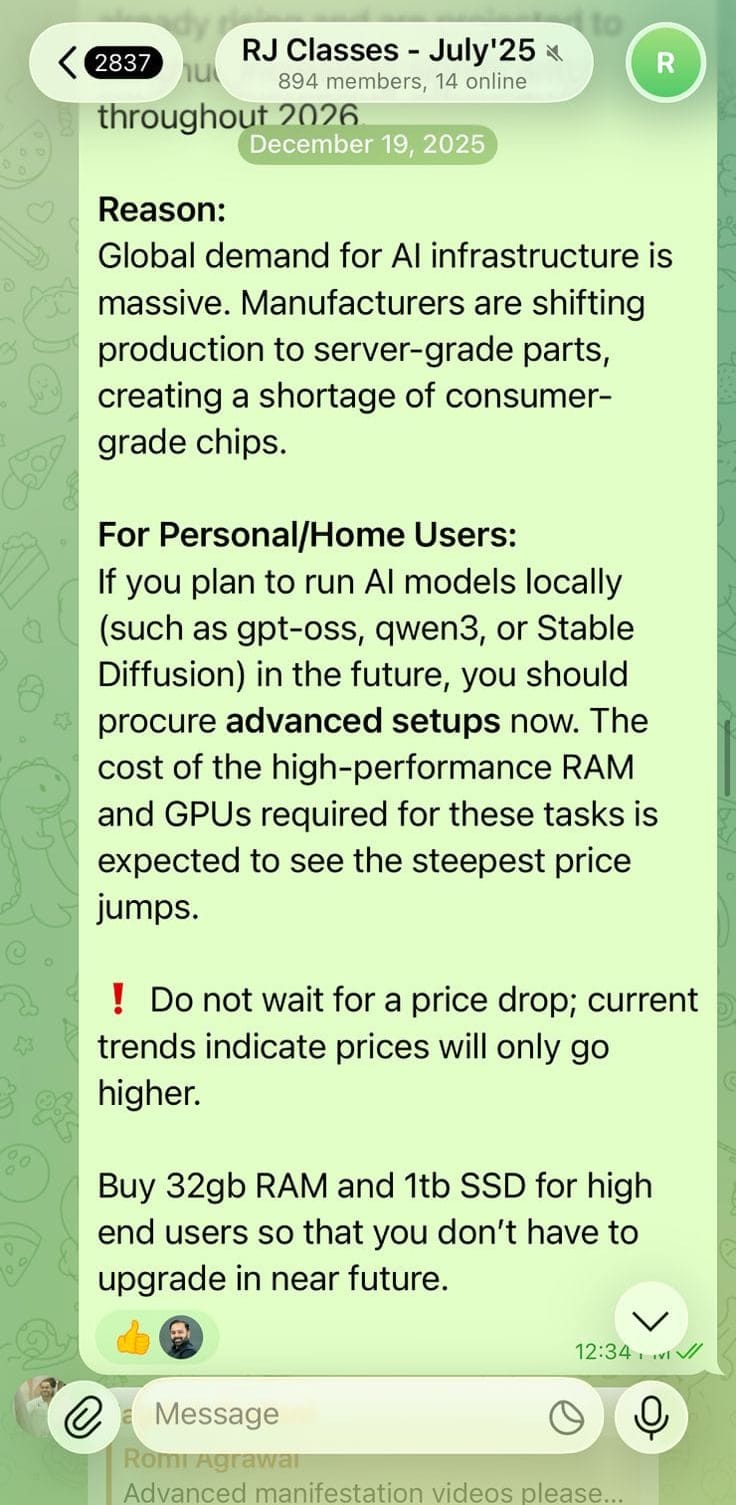
That was five months ago. Look at what has happened on Amazon India since. (As of 20th May 2026)
| Hardware | May 2025 | May 2026 | Change |
|---|---|---|---|
| WD Black SN850X 2TB NVMe | ₹15,999 | ₹44,691 | nearly 3x |
| Samsung 990 Pro 2TB NVMe | ₹16,999 | over ₹40,000 | more than 2x |
| Crucial T705 2TB Gen5 NVMe | ₹33,619 | ₹52,749 | +57% |
| RTX 5090 (Gigabyte Windforce) | ₹3.45 lakh | ₹4.92 lakh | +42% |
| RTX 5090 (ASUS ROG Astral) | n/a | ₹8.00 lakh | premium variant |
| Mac Studio maximum unified memory | 512GB orderable | 96GB ceiling | collapsed |
Why? Every AI data center being built is buying high-bandwidth memory at any price. The same fabs that made your SSD and your RAM kit are now making memory for Nvidia. New capacity does not arrive until 2028.
This is the second-order effect of the AI build-out. It is not just your subscription that costs more because of USR/INR. The hardware you would have used to escape your subscription costs more, and it is getting harder to buy. The bubble does not need to burst for the bill to come due. The bubble inflating is what is raising the prices.
If you have the capital and the appetite, the machinery still exists. It just costs two to three times what it did one year ago. That means, for most business owners reading this, that door is shut.
Which leaves the door that is still open. Long-term contracts. Annual plans. Reserved capacity, All Upfront. Lock the rate while you can.
But if you don't know what to do with AI, locking prices now will mean nothing. In my upcoming AI Mastery Program, you will understand the difference between what kind of tasks require AI access for short term vs long term. So that you can decide what capacity to buy and how much. But this course is only for people who have completed their BMP Program.
What this means for you, this year
| What you pay in dollars* | At ₹85 (May 2025) | At ₹96 (today) | At ₹110 (the trend) |
|---|---|---|---|
| Claude Pro, one seat per month | ₹1,700 | ₹1,920 | ₹2,200 |
| Claude Pro, ten seats, one year | ₹2.04 lakh | ₹2.30 lakh | ₹2.64 lakh |
| ChatGPT Business, twenty seats, three years | ₹18.36 lakh | ₹20.74 lakh | ₹23.76 lakh |
*The pricing might not be up to date.
These are not big jumps in one month. They are big jumps over three years. And this is just subscription. Add cloud spend. Add API spend. Add integration cost. Multiply.
I have seen this exact movie before
Between 2014 and 2024 I watched dozens of Indian businesses delay cloud adoption because "it costs money". They waited. The rupee did not. By the time they signed up to AWS, the same bill was 30% higher in rupees than it would have been if they had moved early.
I am watching the same thing happen with AI right now. Different decade. Same mistake.
"But AI prices are dropping anyway."
In dollars, yes. Per-token prices have fallen sharply. But your subscription seat price is not falling. It is repriced in rupees every month at a worse rate. And the bigger cost is not the seat fee. It is the twelve months of productivity you lose by waiting for a price cut that does not arrive on your invoice.
"But India's IT exports bring in more dollars than this."
Correct. Infosys and TCS send out more in dollars than your Claude bill takes in. That offset is real. Not sure for how long, but for now it's real. Their stock price says a different story, but I won't get deeper into it today.
"But the rupee could strengthen."
It could. It has not, on a trend basis, for thirty years. Plan for the trend. Not the exception.
"I will buy when I need it."
You needed it last quarter. Your competitor in Indore already has it. Your BMP seniors are already using it. The question is not whether you buy. The question is what exchange rate you buy at.
"Wait for an Indian alternative."
Alternative to what? The model? The chip? The memory?
Sarvam, and others are building Indian models. They are not at frontier level yet. By the time they are, you will have lost three years to your competitor.
And when they get there, they will still be running on US made GPUs, trained on Samsung memory, billed in dollars. Every Indian AI model today pays its biggest bill to a US company. There is no Indian alternative to the machinery. The dollars leave the country whether you use Claude or Krutrim.
"It is a small expense today. Why does the rupee even matter?"
Today's seat is small. Today is not the year you are paying for. You are paying for the next three years, when your AI bill is five seats, then fifty, then your operations run on it. The rupee at that point is not today's rupee. Plan for the seat count you will actually have.
It's a good thing that you are a part of the BMP Program. You will know what seat count to purchase much before others.
What to do this week
- Pick one AI tool your business actually needs. ChatGPT, Claude, or Gemini.
- Check with your banker about the Forex Markup on your credit card. There are some who offer 0% but you get dollar at a higher price.
- Buy the annual plan, not the monthly plan. Claude Pro, Cursor, Perplexity, and Google AI Pro all bill the full year upfront in one USD conversion. You lock the rate for twelve months. (Your card will charge a forex markup of about 3.5%, sometimes 1-2% on premium cards.)
- If you use AWS, Azure, or Google Cloud and you are buying reserved capacity, pick "All Upfront". Not Partial. Not No Upfront. Only the All Upfront option actually locks the rupee rate. The others bill monthly in dollars and re-convert every month.
- For one critical function in your business, assign one paid seat this quarter.
- Renew before the rupee crosses ₹100.
This is not about predicting forex. It is not about being clever. It is about not paying tomorrow's price for today's tool.
One last thing
Last time I wrote a post about spending more today to save more tomorrow. It seems like it did not land. Maybe you did not understand it. Maybe you did and chose not to act. I cannot tell from here.
If this one lands, and you want the next post to cover the actual solutions that are available to us right now, open this newsletter in your browser and leave a comment. If this post gets 150 comments, I will write the solution post in full detail.
If it does not, maybe no one is reading.