
Ritvik Aggarwal builds outdoor LED display systems for a living.
The kind that tell you which platform your train leaves from. The kind that flash live air quality numbers outside a construction site. The kind malls use to sell you things you walked in not planning to buy.
Fifty people work at his company, SSPS Global. He has been at it for five years. He comes from a tech background himself.
And yet, for years, the business inside the business ran on memory.
No KPI tracking. No proper data. No workflow anyone could point to. Work got assigned in a conversation and then lived inside someone's head until it either happened or quietly did not.
The part that should bother you
Ritvik is not a non-technical owner who got scared off by software. He understands the tools better than most people reading this. He designs electronics.
So why did his own company run on guesswork?
Because knowing technology and using technology to run a business are two completely different games. Ritvik puts it better than I could.
"I come from a tech background myself. But understanding tech and implementing tech for business are two different ballgames altogether. Implementation of technology to improve your business is the real game changer."
This is the trap almost every owner falls into. They assume the fix is more general knowledge about technology. Ritvik already had that. It changed nothing on its own.
What he was missing was something else entirely. The problem broken down into plain business terms. A simple tool he could put to work without friction. Knowing how technology works does not tell you which small system to deploy on Monday. Someone has to name the problem in your language and hand you something you can use the same week. That translation is the whole game.
What we actually installed
No expensive software. No six-month rollout. Three simple systems.
| System | What it replaced | What changed |
|---|---|---|
| Delegation Sheet | Work assigned verbally, tracked nowhere | Every task now has an owner, a deadline, and a status anyone can see |
| FMS (process mapping) | "Why is this taking so long?" with no answer | Each process is broken into steps, so bottlenecks become visible instead of mysterious |
| Data as intelligence | Numbers sitting in files doing nothing | Data is read as signals that drive decisions, not records that gather dust |
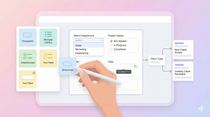
The Delegation Sheet did the heaviest lifting first. Once every task had a name and a date attached to it, accountability stopped being a feeling and became a fact. You could look at one sheet and know exactly what was moving and what was stuck.
"The delegation sheet was a game changer for sure. Now there is proper tracking and accountability of the work assigned."
The FMS came next. When a process drags, most owners guess at the cause. Ritvik stopped guessing. Map the steps, and the slow step shows itself. A bottleneck you can see is a bottleneck you can fix.
The third one was the quiet one. Ritvik learned to treat data as intelligence rather than storage. That single shift changed how he looks at every number his business produces.
"Understanding how data can be used to create intelligence has completely transformed how I see data."
What moved
The numbers went where every owner wants them to go.
Weekly output rose. Significantly. Same team, same hours, more work actually getting finished.
The chasing stopped. Ritvik no longer spends his day asking people whether the thing he asked for is done. The sheet answers that for him.
And his own time got handed back to the work only a founder can do. Strategy instead of follow-ups.
He said it better than any dashboard could. For years he was busy. Now he is a businessman.
"I am able to be a businessman in the real sense now. I can focus on real tasks instead of being busy with tasks that are not important."
The shift did not stop at the office either. At home he is more present for his family. In his own head, calmer. Problems that used to feel like threats now read as things to be solved. That is what happens when a business stops depending on one person remembering everything.
"At home, I have become a positive spirit, there for my family more than before. In my own head, I now see every problem as solvable. I am neither scared nor disheartened by anything in my business."
The lesson sitting in plain sight
I see this pattern in almost every business I walk into. The owner does not need more raw information. They need the problem named in words they actually use, and a tool simple enough that putting it to work takes no willpower. Clarity, then a frictionless tool. That combination is what turns into results.
Ritvik had the technical knowledge already. What changed his business was having the mess broken down into a delegation sheet, an FMS, and a clear way to read his own data. None of it was complicated. That was the point. A tool only works if it is simple enough to survive a busy week.
Ritvik runs SSPS Global, an electronics design firm in Noida. If you need outdoor LED display systems for railways, retail, malls, or air quality monitoring, that is what they build.
If you recognised your own office in his before-picture, the takeaway is not that you should know more or know less. It is that the right problem, explained plainly and handed to you as something you can deploy this week, is what moves the number.
He understood the technology long before any of this. What he needed was someone to make it simple enough to use.
Your story is sitting in a drawer
Ritvik spent about ten minutes telling me what he had built. Now it lives here, with his name on it and a link straight back to his business, working for him while he gets on with his day.
You have a version of this story too. The mess you cleaned up. The system that finally stuck. The evening you stopped firefighting and got to go home on time. You have just never written it down. Sometimes putting your own win on the internet feels a little like bragging.
It is not bragging. It is evidence. Somewhere an owner is stuck exactly where you were two years ago, and your story is the proof that the door opens. You are not pointing at yourself. You are holding that door open for the person behind you.
Tell me what you cracked, and I will write it up just like this.