On 27 January 2025, Nvidia lost 17% of its value in a single day.
That is about 589 billion dollars, gone in one trading session. The biggest one-day loss any company in history has ever taken. More than the entire value of most countries.
The cause was a Chinese AI company almost nobody had heard of. A week earlier, a lab called DeepSeek had released a model that did something the market thought was impossible. It came close to the best American models. And it was built for a fraction of the cost. A few million dollars, where the American giants were spending hundreds of millions.
The market did the math over one weekend. If intelligence can be made this cheaply, the company selling everyone the expensive equipment to build it is suddenly worth far less. The stock fell off a cliff.
It recovered later. This was never really about Nvidia.
It was about the signal. That day was a tremor. The first time the ground moved under an industry everyone thought was solid American rock. And a tremor is never the last one.
This week the ground moved again. Most of you did not feel it. I did. And it made me admit something.
First, what an open model even is.
When you use ChatGPT, the program is not on your computer. It sits on a machine in America. You send a question across, and the answer comes back. You are renting a brain you never get to hold. Stop paying, and it is gone.
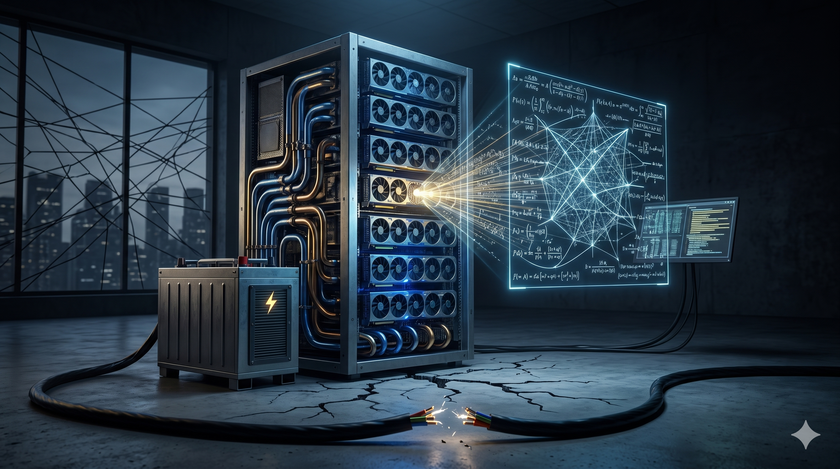
An open model is the opposite. The company that built it puts the whole thing online for anyone to download. The entire brain, as a file. You copy it onto a computer in your own office, and it is yours. It runs on your electricity. It works even with the internet unplugged. Nobody can switch it off, raise the price, or read what you type. The one thing you still buy from America is the Nvidia chip, once, and then you owe no one.
Think of a generator. A rented one runs only while you keep paying the man who dropped it off, and he can take it back any morning. The one you bought sits in your compound and starts whenever you want, for years.
A few companies give these models away. Z.ai in China. Meta, the company behind Facebook and WhatsApp, in America. For years they have been free to download. There was just one catch, and that catch is the whole story of this post.
I was not exaggerating. I was waiting.
For two years I have told business owners that open models are the escape route. I meant it, and I was already living it. You just have to know which work I was talking about.
Your business runs on two kinds of tasks.
The first kind is the same thing on repeat. Answering the questions customers ask forty times a day. Sorting reviews into happy or angry. Tagging a form so it reaches the right desk. The work never changes shape, only the details.
Small open models have been excellent at this for a long time. You can even feed one your own records and train it further, until it knows your business better than a new hire would after a month. The technical word for that is fine-tuning.
I have been running this half of the work on my own machines for a while. No subscription. No dollar bill. For this half, the escape route was already wide open.
The second kind of task is different. Building something new. Writing computer code. Thinking through a messy problem with ten moving parts and no fixed answer to copy. This is the demanding work, and only the most powerful models can do it. People in the field call these the frontier models, the ones at the very front of what is possible.
Here, for two years, the open models fell apart. When the work got hard, I would quietly close the open model and go back to Claude or GPT, paying in dollars, because that was the only place the hard half got done.
So I was not selling a dream I did not believe. Half your work could already run free, on hardware you can own, and I was running mine that way. I just knew the other half was still locked.
I bought the expensive 8 figure machines anyway. Not because they could do the hard half yet, but because I was certain that one day an open model would catch up, and I wanted the machinery sitting ready when it did.
That was like buying a plot in Gurgaon in 2016. I had full conviction it would pay off. I just did not think it would pay off this soon.
You invest in building a factory, a new office, a new showroom. Building a computer that can run these models offline for your company won't cost even a fraction of that money.
This week it held.
Z.ai, the Chinese company I mentioned, has now released a model called GLM-5.2. Open and free to download. The whole brain, yours to keep.
For the last few days I have thrown my hardest work at it. The complex tasks that used to send me back to the American models. The exact work I was paying the premium for.
It held.
This was not "good for a free model" or "almost as good". Side by side with the models I pay a premium for, on my real work, I honestly could not tell which one was better. And GLM-5.2 costs about six times less to run.
For the first time in two years, the cheap option was not also the weak one. The hard half of the work finally walked through the same door the easy half walked through long ago.
That is the second tremor. It is bigger than the first. The first was only about money. This one is about whether the frontier labs were ever as far ahead as their price suggested.
The door I told you was shut.
A few weeks ago I wrote that the rupee will not wait for you. We are renting our intelligence from a country whose currency keeps getting stronger against ours, and the bill only moves one way.
I said something quieter in that post, and this week it stopped being theory. We do not control the tap. Access can be cut off above our heads at any time, for reasons that have nothing to do with us. We watched it happen with Fable 5. One decision in a room on the other side of the planet, and the tool your business runs on is gone, or priced out of reach, or simply blocked for our part of the world. You did nothing wrong. You just did not own the machinery.
The escape route always had two locks. The first was the hardware, getting more expensive every month, and that is what the rupee post was about. The second lock was capability. Even with the machines, an open model could not do the hard half. This week that second lock opened. Although, the hardware will become more costly. What changed is that a free model finally got good enough for the hard half.
But the data goes to China.
Yes. Only if you use it on their servers, your data goes to China. That is a real worry and I will not wave it away. I would just like to point out that the CCTV camera that you have in your kitchen? That's also Chinese.
But look at the honest version of the question. When you use ChatGPT, your data goes to America. When you use Claude, your data goes to America. As an Indian business, you are not choosing between sending your data abroad and keeping it home. That choice does not exist yet. You are only choosing which foreign country it goes to. America or China. Pretending otherwise helps no one.
There is one more door, though, that the frontier models do not give you. Because GLM is open, you can download it and run it on your own machine, inside your own walls, with the internet unplugged if you want. Then your data goes nowhere.
This is exactly why I have spent serious money building my own AI hardware. So the choice is mine, not theirs. Until now that hardware could only run weak models, so it was a compromise. Now it runs a model that matches the frontier. The compromise is gone.
Someday, FAR in the future, India will have enough of its own AI chips, the special processors these models need, to run them on Indian soil at full scale. Even then, be clear about what that fixes and what it does not. Run a model yourself and your data stays yours. Hand it to any hosted service, Indian, American or Chinese, and you have given it away again. What ends the dependency is ownership, not which country built the model.
Nothing is protecting them.
I do not know exactly how this goes for the American AI giants. I will not pretend I do.
But I can see what is in front of me. Every strong business has a wall around it, something rivals cannot easily copy, that keeps customers from walking away. These companies do not have that wall. There is no secret recipe here that money cannot copy. An American company builds something new, and within months a Chinese one matches it, gives it away to the world, and runs it at a sixth of the price. The premium you pay for the best American models buys you a smaller edge every quarter. A lot of what is left is just the comfort of a familiar name.
A business charging extra for something anyone can copy and give away does not stay expensive for long. I would be surprised if the giant we all depend on today is still standing as a giant in a year or two.
That is the whole post
I am not teaching you anything this week. No checklist at the bottom, no tool to set up tonight. This is a heads up, nothing more.
The first tremor cost Nvidia 589 billion dollars and made headlines everywhere. This one made almost none, because it did not move a stock. It moved something underneath the stock. Most people will not notice for a few weeks. You noticed today.
If you want to feel it yourself before you take my word for it, go to chat.z.ai and give it a complex problem. The kind you would normally trust only to the expensive American models. Then remember that it cost you nothing, and that you could have downloaded it and run it on your own machine.
That feeling is the whole point. Sit with it.