
Meta cannot read your WhatsApp messages. But it sees who you talk to, when, and how often. That map of your life is the part worth keeping.
You talk to a friend about running shoes. Just a normal conversation. The next morning you open Instagram and there they are. Running shoes. Three ads in the first minute.
You feel a chill. "It is listening to me. The phone heard us talking."
Here is the truth. Your phone is not listening to your conversation.
This is not me guessing. In October 2025, the head of Instagram, Adam Mosseri, addressed this belief directly, calling the idea of recording people through their phones a "gross violation of privacy." Independent researchers who studied thousands of phone apps found no evidence of secret recording either. The microphone story is a myth.
But read what Mosseri said next. Meta does not need the microphone. It already shows you ads based on what advertisers know about you and on what people similar to you do. With enough data, and now AI, it can predict what you want without hearing a word.
That chill you felt? It is you imagining a person in a dark room, because a person is somehow less frightening than a machine that needs no person at all. And by the end of this, you will know the one move that starves that machine.
It does not need your words. It has your connections.
Meta cannot read your WhatsApp messages, and it does not record your voice. So how does it feel like it knows? Because it knows who you are connected to, more completely than you would believe.
Here is a fact that is documented. Researchers from Northeastern and Princeton tested it and Facebook confirmed it: Meta builds a profile of you out of other people's phone contact books. Every time someone you know taps "allow access to contacts," your name and number get uploaded. Meta now knows you are connected to that person, whether you ever agreed or not.
It gets sharper. Those researchers found that a phone number you gave Facebook only for two-factor security, to protect your account, became usable for ad targeting within weeks. You handed it over for safety. It became a way to find you. Facebook admitted it, and the practice was named by the US Federal Trade Commission in the case that ended with Facebook paying a record five-billion-dollar fine. (This is not a reason to switch off two-factor security. Keep it on. It is a reason to see how far data reaches once Meta has it.)
This is called a shadow profile. Information about you, gathered from everyone around you, that you never typed in and cannot see.
On top of that, any business that already has your phone number or email can hand that list to Meta. Meta matches it against its users and shows ads to those exact people. Meta calls this a Custom Audience. It is not a rumour or a leak. It is a standard feature Meta documents on its own help pages and sells to advertisers.
So when the shoe ad appears, nobody needed to hear you. You are connected to people who looked at shoes. You sit inside some list a business uploaded. You resemble buyers Meta already tracks. Nobody at Meta cares about your secret; there is no detective on your case. Meta is a salesman, and a salesman does not need your words. It needs to know you well enough to nudge you. The connections did that work. The microphone was never required.
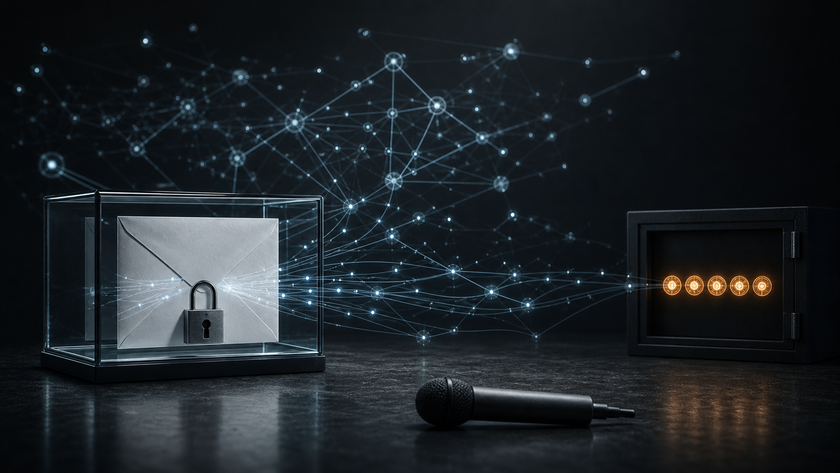
The letter is sealed. The envelope is not.
Now, to be fair: Meta genuinely cannot read what you write. WhatsApp chats are end-to-end encrypted. They are scrambled on your phone, unscrambled only on the other person's, sealed even from WhatsApp in between. It uses the exact encryption a company called Signal invented. That part is real and genuinely good.
But the words were never the valuable part.
When you post a letter, the postman cannot read what is inside the sealed envelope. But he can read the outside. Who you wrote to. How often a letter goes to that same address. The date. The city.
WhatsApp seals the letter. Then it keeps a record of every envelope. This record is called metadata. Here is what is on your envelopes, every day:
- Which numbers you message, and how often
- What time, day and night
- Who is in which group with you
- Every contact in your phone
- Which phone you use and roughly where you are
- And, crucially, that this WhatsApp belongs to the same person as that Instagram account and that Facebook account
The words inside are locked. But the map of your entire life, who you know and how you move, is written on the outside in plain ink, and Meta keeps it. You lock your front door not because you are a criminal, but because what is inside is yours. The same is true of this map. (One company, you will see shortly, chose to keep no envelope at all.)
"So it shows me shoes. Who cares?"
Fair question. A shoe ad is harmless. But two things make the envelope worth knowing about.
It is kept forever. Meta is worth well over a trillion dollars; storage is cheap. The map of who you talked to in 2026 will still be sitting on a hard drive in 2040. And the tools to read it keep getting cheaper. Analysing one ordinary person's full history is not worth anyone's time today. There are billions of people. But AI makes sense of huge piles of data more cheaply every year. What is too expensive to bother with today becomes a single cheap query tomorrow. The data you hand over now will be read by tools that do not exist yet. That is exactly why moving those conversations to a different app this week keeps them off that future map.
And metadata is enough to decide big things about you, and it can be wrong. In a 2014 debate, the argument on the table was that metadata reveals so much you barely need the messages. The former head of both the NSA and the CIA, General Michael Hayden, did not disagree. He went further: "We kill people based on metadata," he said. Not the content of calls. The pattern around them. Who, when, how often.
And the pattern can be read wrong. A government program once scanned the phone metadata of millions of people and ranked them by how closely each person's movements and calls fit a profile it was searching for. Its single highest-scoring match turned out to be a senior journalist, who was simply doing his job: traveling and talking to sources. The system had nothing but his metadata, and on that alone it placed him at the very top of its list. You can read what happened here.
That is not about you, and Meta is not a government. The point is what metadata is, in anyone's hands. Who you talk to, when, and how often is enough to decide who a person is. Sometimes correctly, sometimes badly wrong. A government did it with this kind of data. But it is the same kind of data that almost every app, telecom, and company quietly collects today, WhatsApp among them. Hold that thought, because there is one app built so it keeps none of it at all.
This is not paranoia; it is the contract. When you use WhatsApp, the deal is simple and unspoken: your words are private, but the map of your relationships belongs to Meta, forever, to be used to influence you and handed to whoever can legally demand it. And it is demanded. Meta publishes the numbers itself. In 2022 alone, governments and law enforcement made more than 470,000 requests to Meta for user data, and Meta produced at least some information in roughly three out of four cases. None of it requires breaking the encryption. The envelope is enough.
The proof that restraint is possible
Earlier I mentioned Signal, the company whose encryption WhatsApp borrowed. You have probably never heard of it. That is normal.
Signal is a free messaging app. It looks and works almost exactly like WhatsApp. Send a message, make a call, create a group. The difference is not on the screen. It is in what gets stored.
There is a simple test for how much a company knows about you: what can it hand over when a court orders it to. Courts have ordered Signal to do exactly that, more than once. The most it has ever been able to produce is two things: the date an account was created, and the date it last connected. Not the messages. Not the contacts. Not the groups. Not who you talk to.
Two timestamps. That is the whole envelope. Signal could hand over nothing more, because it collects nothing more. It is run by a non-profit. It does not sell ads. It has no salesman, so it has no reason to keep the map. The watcher can be starved. Here is how you do it.
You keep WhatsApp. You move five people.
You cannot leave WhatsApp, and you should not try. Your customers are there. Your suppliers are there. Your school groups are there. Keep it for the world. You are only moving the conversations that are actually yours: family, your partner, the handful of people who are your real circle. Move those, and the most telling part of your map comes off the table. Do it as a small habit, not a big decision: nobody switches apps over an argument; people switch because the new app sits where the old one was and the people they love are already on it.
This week
Day 1. Install Signal. Put its icon in the exact spot where WhatsApp sits now. Your thumb already knows that spot. Push WhatsApp one screen away, into a folder.
Day 2. List the five people you message most. Send each one line: "Install Signal, I will message you there from now." Five people. Not fifty.
Day 3 onwards. Every time you reach to message one of those five, open Signal. Slip and open WhatsApp by habit? No guilt. Close it, open Signal. You are not building a habit from nothing. You are redirecting one that already fires ten times a day. The thumb learns fast.
End of week. Turn on disappearing messages in those chats, if you don't want your private conversations to pile up anywhere at all.
Do this for one week. Your closest conversations are off Meta's map. WhatsApp keeps doing its job for the world. And the picture of who you really are stays yours.
A few honest notes
The other person has to be on it. Signal only works if both sides use it. That is exactly why you start with the five people you talk to daily, not with strangers. Frequency is what makes it stick.
Your WhatsApp backup is the soft spot. Your messages are encrypted while traveling, but the backup sitting in your Google Drive or iCloud may not be, unless you have turned on encrypted backups inside WhatsApp settings. If anything sensitive stays on WhatsApp, turn that on. Better, keep the sensitive talk on Signal, where there is nothing to back up.
This is not about hiding. You are doing nothing wrong by messaging your family or your vendor. The record of who you talk to, when, and how often is simply nobody's business but yours.